
What Most People Get Wrong
You walk through the front door after a long day, flip the switch by the frame, and the hallway still looks flat and shadowy. A single overhead fixture throws light straight down, leaving the corners dark and the mirror by the closet barely useful. This is one of the most common complaints homeowners raise about entry spaces, and it rarely has anything to do with bulb wattage. The real issue is almost always about fixture placement, light direction, and how a foyer gets used compared to how it was originally designed.
Most people assume a brighter bulb will fix the problem, so they swap in a higher-lumen replacement and call it done. That approach treats the entryway like a single room instead of a transition space that connects the outdoors, the stairs, and the rest of the house. A brighter bulb in the wrong fixture just makes the glare worse near the door while the far wall stays dim. Homeowners also tend to pick fixtures based on size alone, choosing something small because the entry feels cramped, when a taller or wider design would actually distribute light more evenly across the space.
Another mistake shows up in color temperature. Many entryways get stuck with leftover bulbs from another room, often a cool white that feels clinical rather than welcoming. Guests notice this shift the moment they step inside, even if they can’t name why the space feels off. That inconsistency is subtle, though it’s often the first detail visitors register even before they consciously notice the mismatch. The mismatch between the entry’s lighting and the warmer tones used in adjoining rooms creates a jarring transition that undercuts the whole first impression.
What Actually Works
Layering light sources solves most of what a single fixture cannot. A ceiling fixture handles general illumination, while a console lamp or wall sconce fills in the shadows near furniture and doorways. This combination lets the entry adjust with the time of day, since morning light through a sidelight window behaves very differently than evening darkness. The goal is even coverage rather than one bright point competing with the dark corners around it.
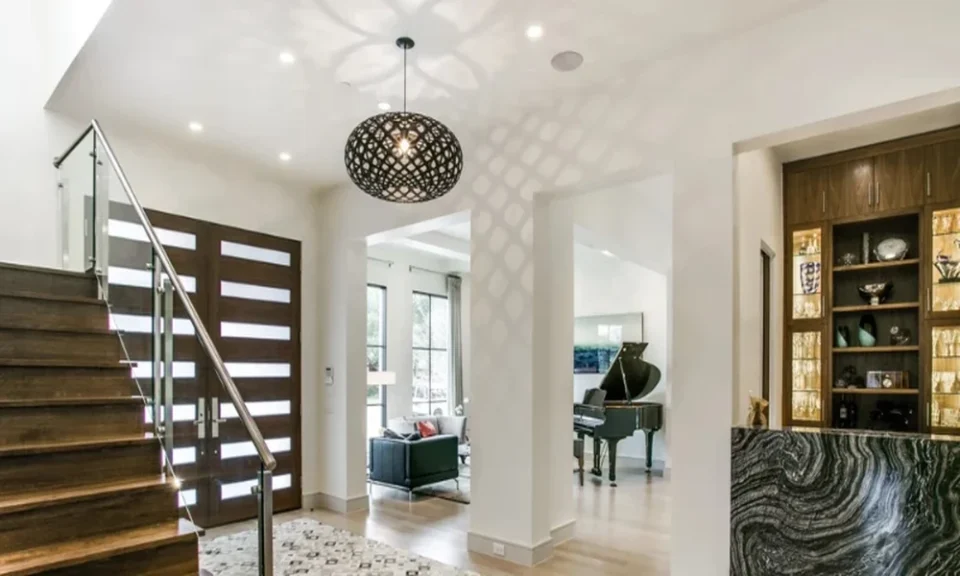
Scale matters just as much as placement. A fixture that’s proportioned to the height of the entry, rather than the square footage of the floor, keeps the space from feeling either overwhelmed or underlit. Foyers with two-story ceilings benefit from a fixture that drops lower into the sightline, pulling the eye upward without leaving the lower half of the room dark. Single-story entries do better with a flush or semi-flush design that clears doorways while still spreading light across the walls. This is especially true in narrower entries, where a fixture hanging too low can make the passage feel tighter rather than brighter.
Color temperature consistency also plays a bigger role than most people expect. Choosing bulbs in the 2700K to 3000K range keeps the entry feeling warm and connected to adjoining living spaces, rather than clinical or disconnected. This small adjustment often does more to improve how an entryway feels than swapping the fixture itself.
How to Apply This
Start by looking at your entry as its own lighting zone rather than an extension of the living room or hallway. If the existing fixture sits directly overhead and nothing else, adding a wall sconce or console lamp near the door creates a second light source that softens harsh shadows immediately. For anyone updating a foyer with higher ceilings, an entryway chandelier can serve as the anchor point, pulling the eye upward while still throwing enough light outward to cover the walls and floor below. Measuring the ceiling height before choosing a fixture size prevents the common mistake of picking something too small for the volume of the space.
Once the fixture is chosen, matching bulb temperature to the rest of the home keeps the transition from feeling abrupt. Checking wattage equivalents against actual light output, rather than relying on old habits from incandescent bulbs, avoids overspending on brightness the space doesn’t need. The ENERGY STAR lighting guidance page breaks down lumens, watts, and efficiency ratings in plain terms, which makes it easier to shop for replacement bulbs without guessing. Combining that information with a fixture proportioned to the room’s height solves most of the dimness complaints homeowners raise in the first place.
Small changes compound quickly once the layering and scale issues are addressed. A homeowner who adds one secondary light source and adjusts bulb temperature often notices the difference within a single evening, without touching the wiring or the layout of the room. Entry spaces get judged fast, by guests and by the people living there every day, so the return on a modest lighting update tends to show up almost immediately. Getting the basics right the first time saves another round of bulb swaps and fixture returns down the line.
